
Unify your learning data
Bealink LRS centralizes, standardizes, and stores learning data from across your entire learning ecosystem.
Trusted by 100+ organizations






360° visibility across your learning ecosystem
Built on the xAPI standard, Bealink LRS captures learning data from every component of your ecosystem. Learning records are centralized in a single repository, making it easy to automate workflows, generate actionable insights, and power advanced learning analytics.
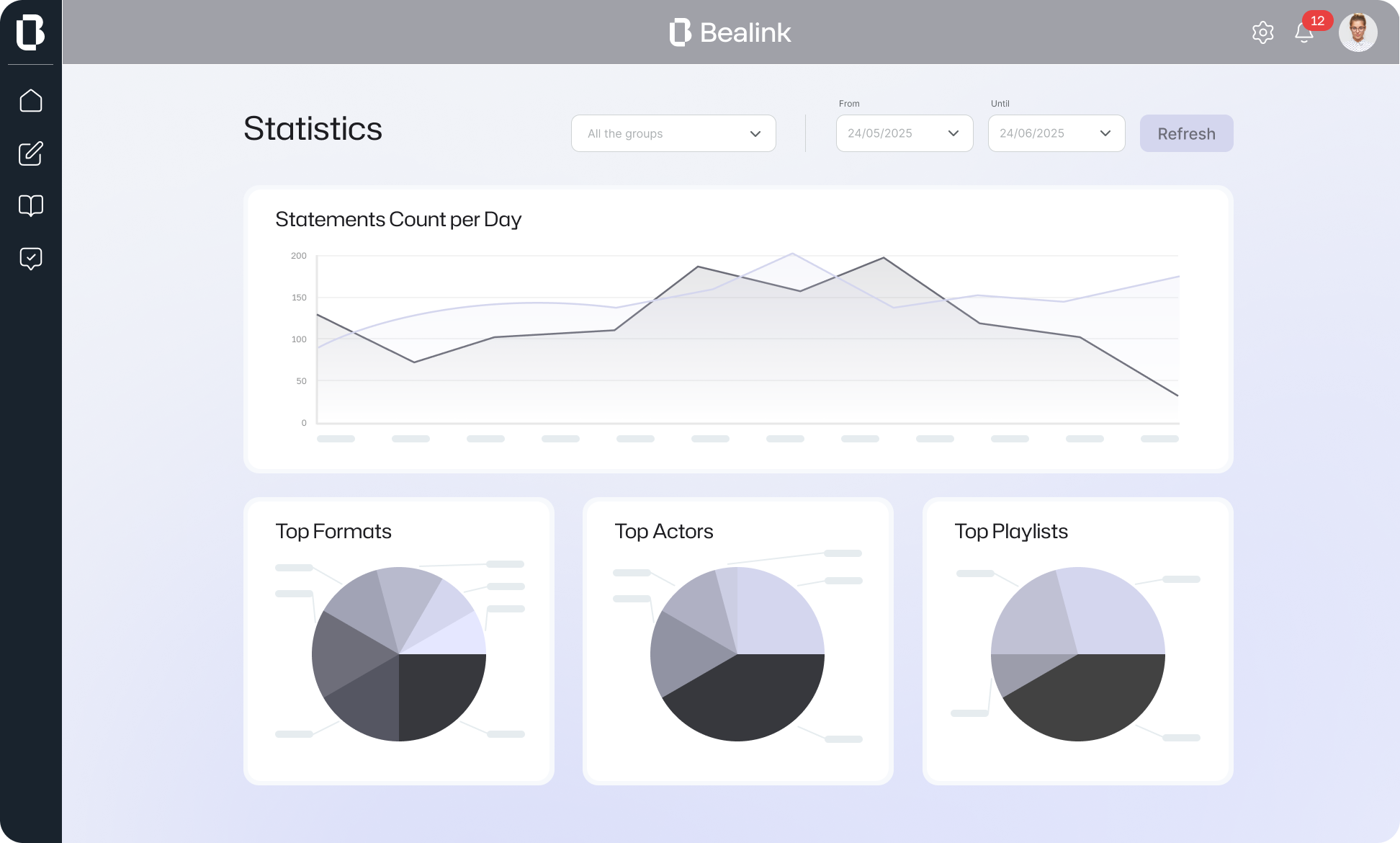
A connected analytics layer gives administrators and managers the visibility they need while seamlessly integrating with Business Intelligence platforms. Hosted in France or Europe, Bealink LRS ensures full control over your learning data while enabling continuous enrichment of your ecosystem.

Core LRS capabilities
Three foundational capabilities that transform learning data into a strategic asset for your Learning & Development organization.
One source of truth for every learning record
Bealink LRS collects xAPI statements from every learning experience—LMS, LXP, virtual classrooms, mobile learning, business applications, simulations, and more—and stores them in a centralized Learning Record Store.
Turn learning data into actionable insights
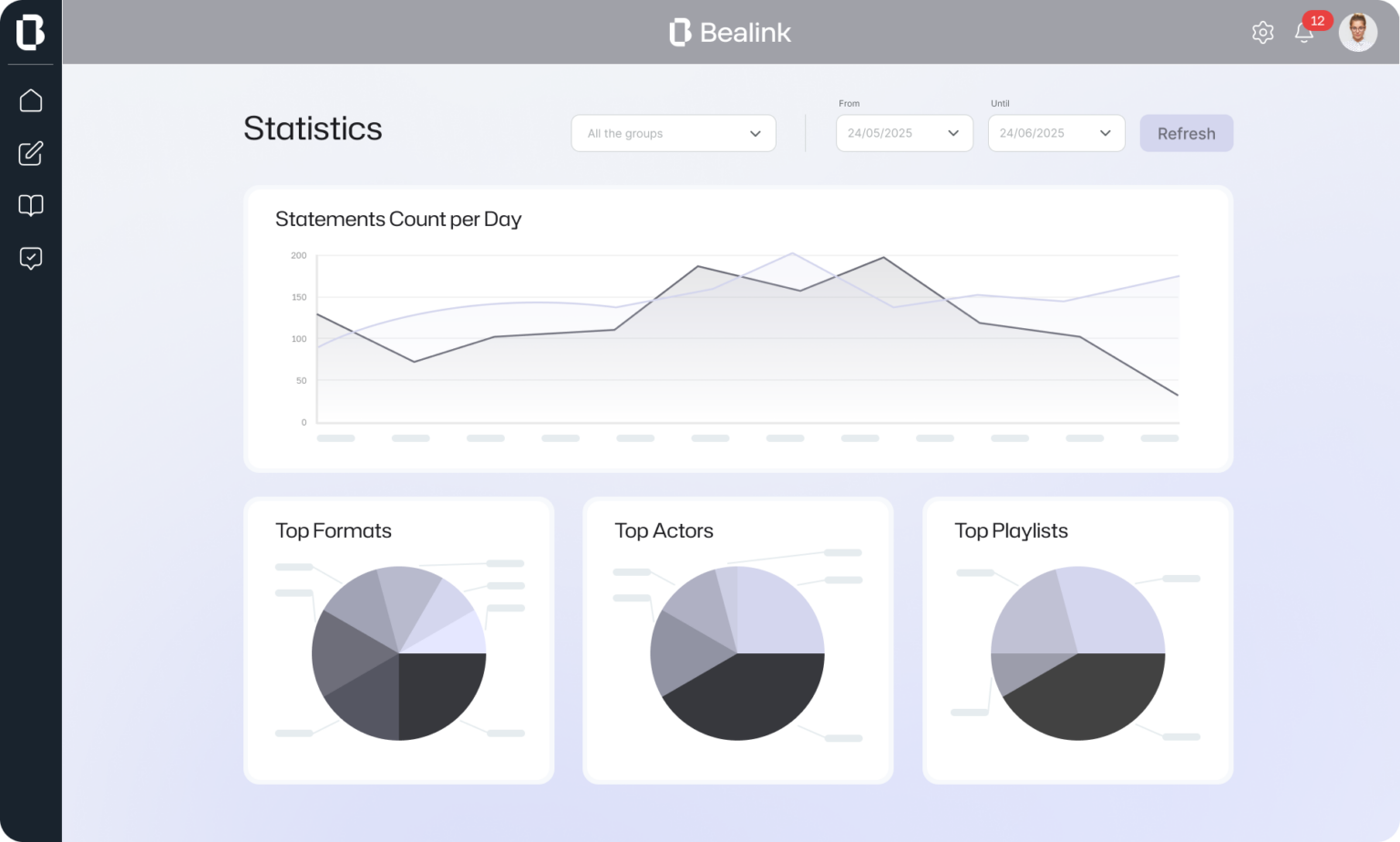
Dedicated manager dashboards are directly accessible within the LXP, ensuring every stakeholder has the right information at the right level.
Managers can independently monitor team progress, identify development opportunities, and make informed decisions—turning learning into a shared responsibility rather than a standalone reporting process.
Your learning data. Always yours.
Manage roles, permissions, catalogs, learning paths, enrollment campaigns, and organizational structures through a governance model that scales with your business.
Because your data remains fully portable, you’re never locked into a vendor ecosystem and retain complete ownership of your learning records.
Why choose Bealink LRS?
Four reasons why Bealink LRS is more than just an enterprise Learning Record Store—it becomes the analytics foundation of your L&D strategy.

Eliminate learning data silos
Aggregate learning records from every platform into one centralized repository.

Standardize your learning data
Normalize learning records using xAPI to ensure consistent, reliable reporting.

Gain actionable insights
Transform raw learning data into dashboards and analytics that support better business decisions.

Drive continuous improvement
Leverage learning intelligence to optimize programs, measure impact, and improve learner engagement.
Move beyond completion tracking to strategic L&D analytics
Learning data is valuable only when it drives better decisions. Bealink LRS shifts your organization from tracking learning activity to measuring business impact.

Without an LRS
- Learning data remains fragmented across platforms
- Reporting is limited to individual systems
- Difficult to measure business impact
- Manual data consolidation
- Limited visibility for managers

With Bealink LRS
- Consolidated learning data across your ecosystem
- Enterprise-wide analytics and reporting
- Performance indicators aligned with business objectives
- Real-time dashboards and automation
- Managers gain direct access to actionable insights
AI that powers your learning ecosystem
Discover how AI agents help organizations transform learning data into intelligent, business-ready insights.
Bealink combines LXP and LMS features, and its analytical capabilities are based on an LRS. Its performance in terms of metrics is impressive, and for those who remember the original purpose of an LRS—it’s rare to see providers use it as intended—this is exactly what it does.
Craig Weiss, Learning Analyst — Brandon Hall Group Technology Excellence Awards, Best Advance in Learning Management Technology

Frequently Asked Questions About the Bealink LRS
What is a Learning Record Store (LRS) and what role does it play in a learning ecosystem?
A Learning Record Store (LRS) is a centralized repository that collects, stores, and retrieves all learning data generated across a training ecosystem: LMS, LXP, business applications, classroom sessions, and third-party tools. Unlike an LMS, which delivers content, an LRS captures what learners actually do — regardless of where learning takes place. It operates on the xAPI standard, which records any learning activity in a structured, machine-readable format. Bealink LRS serves as the data backbone of your entire training setup.
What is the xAPI standard and why does it matter for learning data management?
xAPI (also known as Tin Can API) is an open protocol that tracks and records all learning activities — online, face-to-face, informal, simulated — as structured statements (e.g., “Alice completed this course”, “Bob watched this video”). Unlike SCORM, xAPI is not limited to e-learning content hosted on an LMS: it captures data from any source and centralizes it in an LRS. Bealink LRS is built on a native xAPI implementation, standardizing multi-source data from across your ecosystem and making it ready for advanced analysis.
How does Bealink LRS consolidate data from multiple sources?
Corporate learning is inherently fragmented: e-learning content, classroom sessions, business tools, mobile apps, third-party platforms. Bealink LRS aggregates all of these sources into a single point, normalizes the data to the xAPI standard, and makes it centrally accessible. This consolidation delivers a 360° view of each learner’s journey, reveals learning patterns at organizational scale, and powers automations — for example, triggering an action in the TMS or LMS based on an activity recorded in the LRS.
Does Bealink LRS guarantee data sovereignty and security?
Yes. Bealink LRS offers sovereign hosting, giving you full control over your data: you know where it is stored, who can access it, and how to retrieve it. Your learning data does not depend on an external vendor and remains fully accessible at all times. This is especially critical for large organizations subject to regulatory compliance requirements (GDPR, internal data security policies) or operating in sensitive sectors such as energy, finance, or defense.
How does Bealink LRS integrate with Business Intelligence tools and the rest of the Bealink suite?
Bealink LRS comes with a native admin dashboard that provides full visibility across the ecosystem’s data. It can also connect to external BI tools (Power BI, Tableau, etc.) for in-depth analysis and custom reporting. Within the Bealink suite, the LRS communicates directly with the LMS, LXP, and TMS: the data it collects enriches content recommendations, feeds skills dashboards, and enables real-time compliance monitoring. Additional third-party sources can be integrated over time to increase data granularity as the ecosystem evolves.